 optimium
Let’s talk
optimium
Let’s talk
Capturing the market narrative

Predicting price changes with early signal
The setting
A crypto market intelligence platform ingesting thousands of social posts per hour and providing real time analytics and insights to traders.
The challenge
Early signal in cryptocurrency markets is essential for predicting price movements. This early signal exists in the narratives that circulate primarily in social media and the news. By the time this gets reflected in the price charts it’s already too late. The challenge is to extract market intelligence and early signals for crypto projects from social media activity at scale, including how narratives spread through communities. Quantify the potential of a project before this is visible to its token price in the charts. Social media posts contain lots of noise, spam and false information. Identify legitimate projects and filter out noise.
Why a custom solution
There was no product to buy, because the method didn’t exist. Measuring how a narrative spreads across communities, and linking that spread to price movements, required something new: a dynamic knowledge graph of key opinion leaders, built by AI agents, and an entropy-based measure of narrative diffusion designed and validated for this project.
The work
The project required a substantial knowledge layer to support agentic workflows and quantitative analytics. The stack included TypeScript, Python, Neo4j, MongoDB, LangGraph, and complex network analysis.
We first constructed a dynamic knowledge graph of the market. Its principal entities were key opinion leaders; the connections between them represented how well they appeared to know one another. An agentic AI workflow examined public social-media profiles and posts, then researched the web to infer those relationships. Complex network analysis identified communities within the graph. These communities provided a way to represent how a narrative evolved and relate its spread to the price movement of a crypto project (Figure 2).

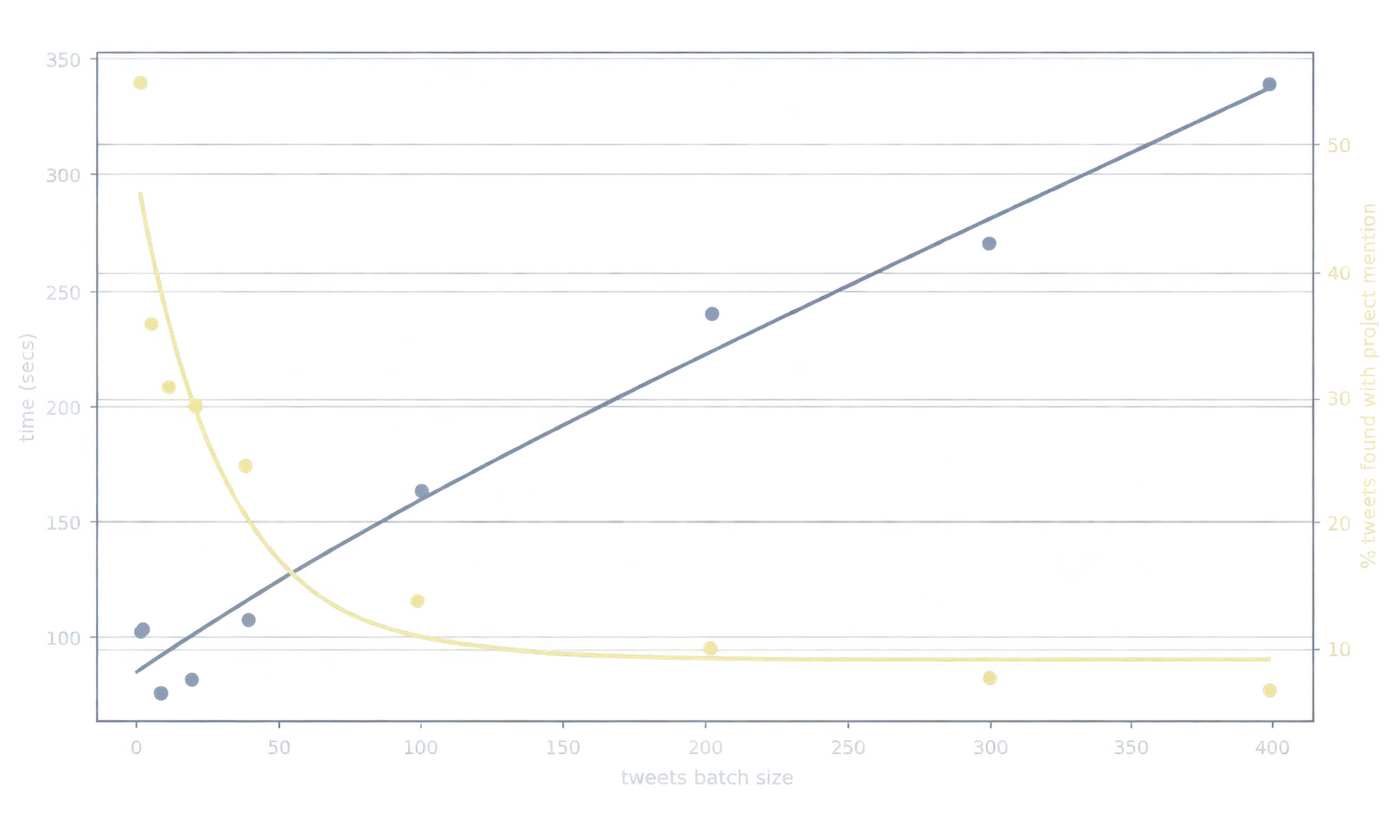
Next, we built an AI data pipeline to extract the signal from thousands of social-media posts in real time. The share of posts yielding a project mention fell sharply as the batch size sent to the language model grew, while processing time increased (Figure 3). This trade-off helped us choose a batch size that balanced signal recovery with throughput.
To score each project identified by the pipeline, we used an entropy-based measure of diffusion: how widely its narrative had spread across distinct communities. For example in Figure 1 we can see that discussion about a project spread from one community to more than 20 communities within days. This is a clear sign of a viral phenomenon that will result in market price changes. This is what we measure, and empirical tests showed that our measure consistently anticipated subsequent price changes.
The results
- An agent with more than 450,000 followers on X.
- Ingestion pipeline throughput increased from 10 to 350 projects with signals per hour, a 35-fold improvement.
- Reduced hallucinations in the X agent to near zero.
- A market research agent outperformed human market analysts in identifying promising projects.
- A price change prediction agent achieved 80% accuracy.