 optimium
Let’s talk
optimium
Let’s talk
AI as an attachment to books

Every answer correct, nearly twice as fast as ChatGPT
The setting
Much of the reading in schools and universities has moved to digital content. Students and researchers increasingly turn to AI tools to learn, instead of the original sources: books and papers.
The challenge
Tools such as ChatGPT and Gemini Notebook were built as general-purpose chatbots, not as study tools or reading assistants. The challenge was to design and build an AI reading companion fast enough to keep pace with the reader’s train of thought, accurate and trustworthy, and able to offer a genuinely rich reading experience. It had to:
- be faster and more accurate than general-purpose chatbots such as ChatGPT, Claude and Gemini Notebook
- work well on mobile
- parse large books and extract their logical structure
- hold a conversation with the reader and explain concepts
- produce printable, book-quality exercises with solutions
- draw graphs and diagrams to illustrate ideas
- be natively multilingual, for studying books in different languages
Why a custom solution
A general-purpose chatbot puts the conversation at the center and treats the book as one more attachment. A reading companion has to do the opposite: keep the book at the center, know its structure, and ground every answer in its pages. That called for an agent built around the book, not a chatbot with a file upload.
The work
We built a system on a LangGraph-based architecture that answers questions with page citations, solves exercises step by step, generates printable LaTeX exam PDFs, produces interactive self-graded tests, and draws TikZ-rendered diagrams on an interactive blackboard. A React 18 single-page app, also packaged as an iOS and Android app with Capacitor and as a progressive web app, fronts a FastAPI backend. The backend drives a LangGraph ReAct agent with 15 tools and progressive-disclosure skills, hybrid semantic and BM25 retrieval, and a separate vector and SQLite store for each book. Its features include:
- Question answering specific to each textbook.
- Page-level citations on every answer.
- Exam generation as printable PDFs, typeset in LaTeX.
- Interactive, self-graded tests.
- Illustrative diagrams drawn on demand.
- Step-by-step problem solving.
- Native multilingual support.
- Awareness of the book’s logical structure.
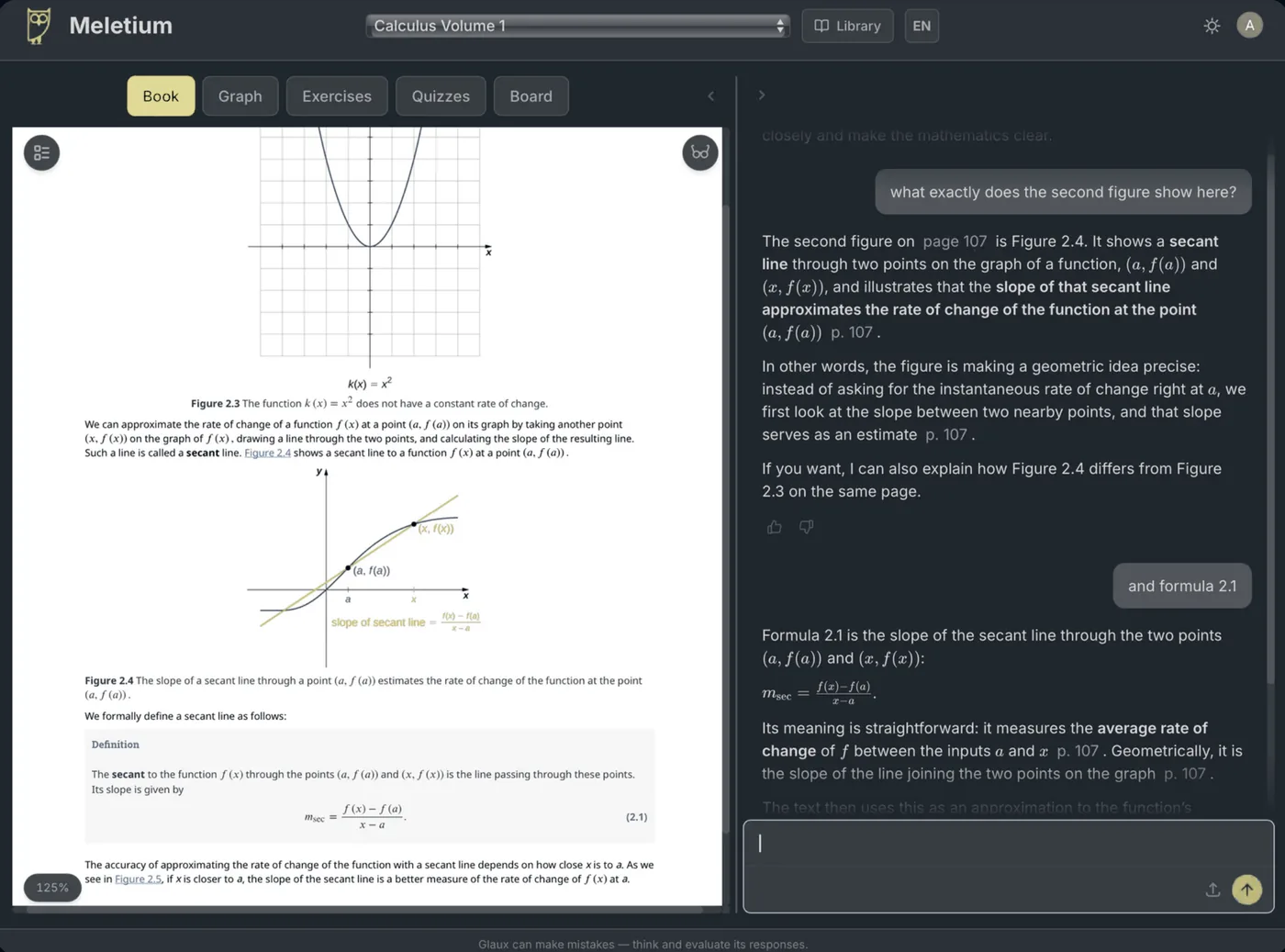
The book stays open next to the conversation. The reader asks about a figure or a formula on the page, and every answer points back to the page it comes from (Figure 2).
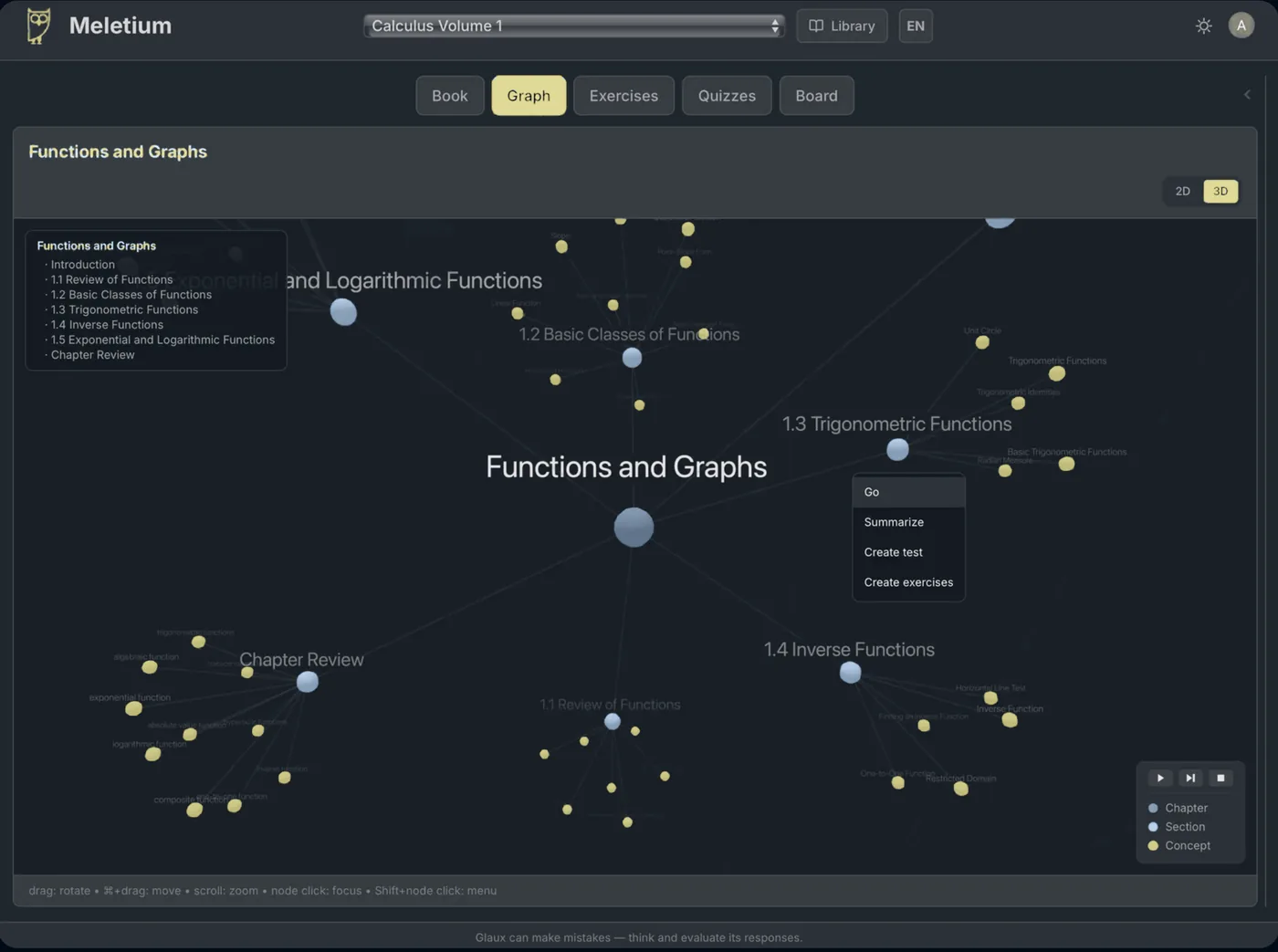
Each book is parsed into its logical structure: chapters, sections and the concepts they introduce. The reader can explore this structure as a graph and, from any node, ask for a summary, a test or a set of exercises (Figure 3).
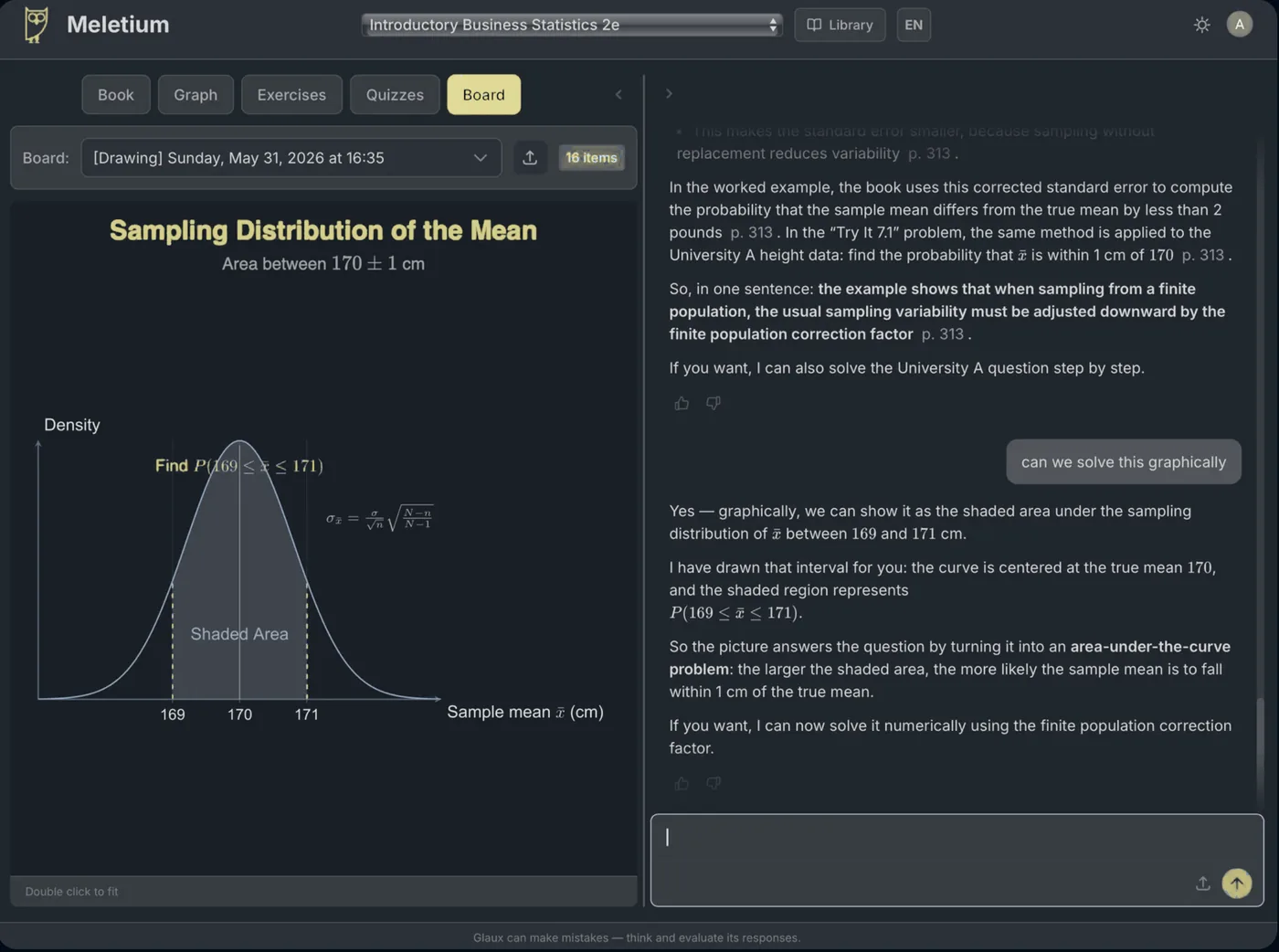
When a picture explains more than words, the agent draws it. Asked to solve a statistics problem graphically, it draws the sampling distribution on the blackboard and shades the probability being asked for (Figure 4).
The results
We compared Meletium with the free tiers of ChatGPT, Claude Projects and Gemini Notebook on the same 972-page calculus textbook and the same 25 questions.
- An average answer time of 20.5 seconds, against 35.9 for ChatGPT, 56.3 for Gemini Notebook and 72.0 for Claude Projects: nearly twice as fast as the fastest alternative.
- All 25 questions answered correctly, against 19 to 23 for the other tools.
- Every answer fully grounded in the textbook, with page-level citations.
- A conversational experience where the book is the primary focus and the AI is the attachment, not the other way around.
The full comparison is on the Meletium blog. Try Meletium free at meletium.com.
← All selected work